Photography students bring “Home” into focus
Home can be a place, a person, a memory, or a feeling, and an NMIT student exhibition captures all of these possibilities through photography.
Skip Links


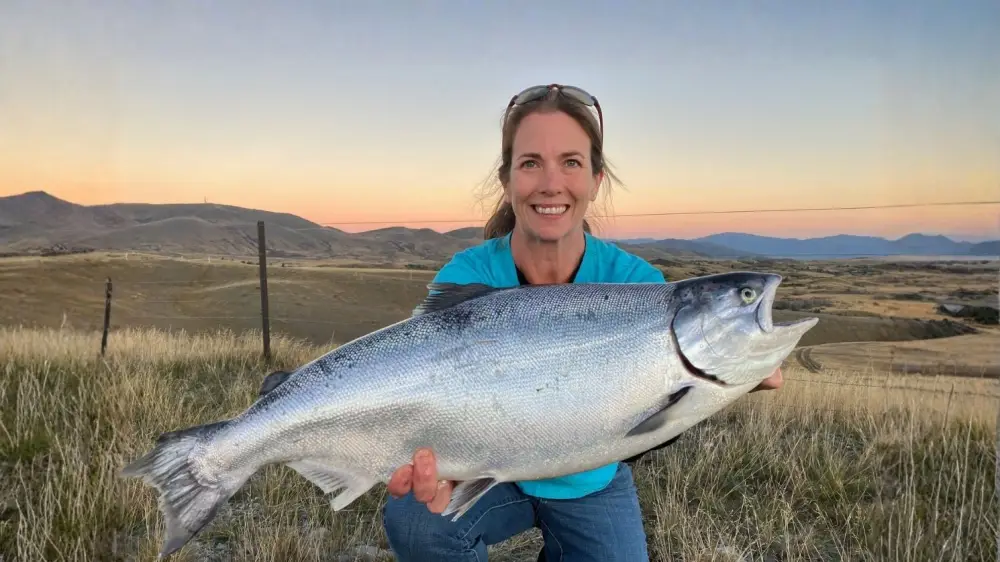
Jamie graduated with distinction as the first student to complete NMIT's Master of Applied Science(external link), following research into improving the success of farmed Chinook salmon. Her findings are already being tested by aquaculture companies and have paved the way for the next stage of her research journey - a PhD.
Originally from Seattle, Jamie moved to New Zealand with her family in 2018 after a career teaching science, mathematics and engineering in the United States. Looking to stay connected to biology and environmental science, she discovered NMIT's aquaculture programme.
"I never really left!" says Jamie. "I loved the research I was doing, and that led to opportunities to stay on at NMIT."
Since then, Jamie has progressed from postgraduate student to Technical Coordinator and Laboratory Manager, supporting NMIT's science facilities while continuing to build her own research career.
Jamie's master's research focused on improving the success of Chinook salmon as they transition from freshwater to seawater – a critical stage in salmon farming.
Her work investigated whether changing the amount of daylight young fish receive before transfer could improve their development. The results were significant, dramatically reducing the number of fish that failed to thrive after entering seawater.
While further industry testing is underway, aquaculture companies have already begun trialling the lighting approach in commercial settings.
"That's the part I enjoy most," Jamie says.
“I've always loved research that has a direct impact on industry and on people who can actually use the information. I enjoy solving problems that have practical answers.”
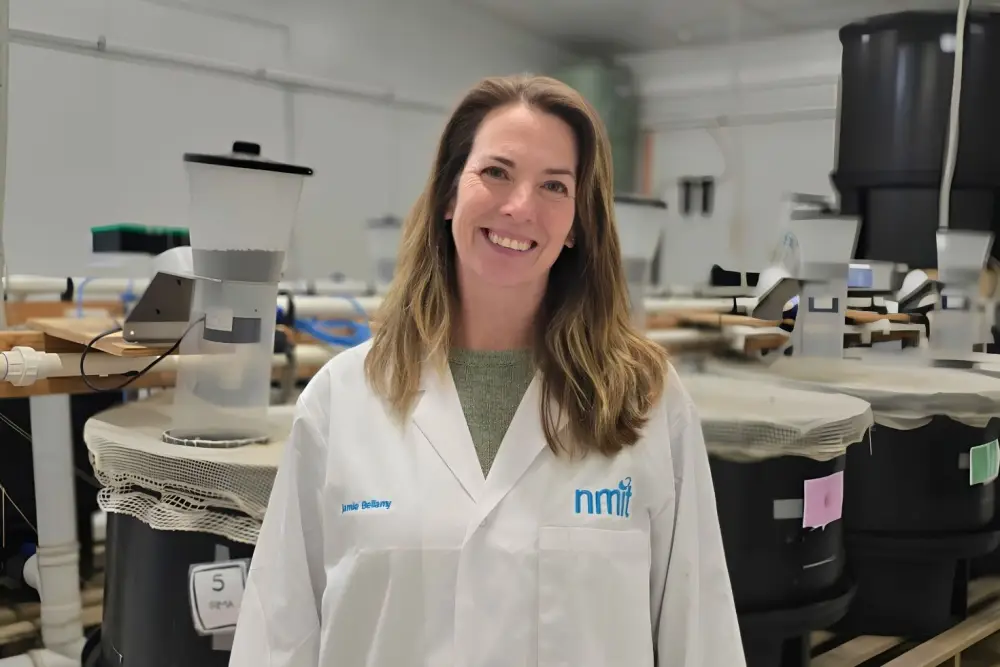
For Aquaculture Programme Manager and research supervisor Mark Burdass, Jamie's achievement reflects exactly what the programme was designed to achieve.
"Jamie's work is a great example of what applied research at NMIT is all about," says Mark. "She has taken a real challenge facing the aquaculture industry, approached it with curiosity, diligence and scientific rigour, and produced findings that have genuine potential to improve industry practice."
Her research also explored the use of artificial intelligence to identify, from photographs, which fish may be likely to struggle later in life – work she hopes to continue through future research.
Alongside her own research, Jamie manages laboratories across NMIT's science programmes and continues to work closely with industry partners on applied research projects.
She credits much of her success to the people around her. Throughout her master's, she received support from NMIT's Research Office, Campus Services, her supervisors and colleagues, as well as industry partners who contributed expertise, facilities and funding.
"I felt supported the entire way," she says.
“It's a lot of work, but it feels like a small family and you feel looked after. I feel very fortunate to have had the opportunity.”
That support also enabled Jamie to present her research at an international aquaculture conference in Darwin, where she shared her findings with researchers from around the world and received strong interest in the artificial intelligence component of her work.
Mark says Jamie's success also highlights what makes applied research at NMIT distinctive.
"Jamie has set a fantastic benchmark as the first graduate of our Master of Applied Science," he says.
“She has shown what's possible when talented researchers are supported by the right people, facilities and industry connections.”
"That's exactly the kind of environment we're continuing to build, and we hope Jamie will be the first of many graduates making an impact through applied research."
Jamie isn't stopping at a master's degree.
Her research has already opened the door to a PhD, which she plans to begin later this year. Based at NMIT in partnership with AUT, the project will continue investigating ways to improve salmon health and production while expanding the use of emerging technologies such as AI.
For Jamie, it feels like the natural next step.
"I love the research and I love working with salmon," she says. "I'm passionate about asking questions and exploring the answers."
As NMIT's first Master of Applied Science graduate, Jamie hopes she won't be the last.
"Hopefully there are lots more to come."