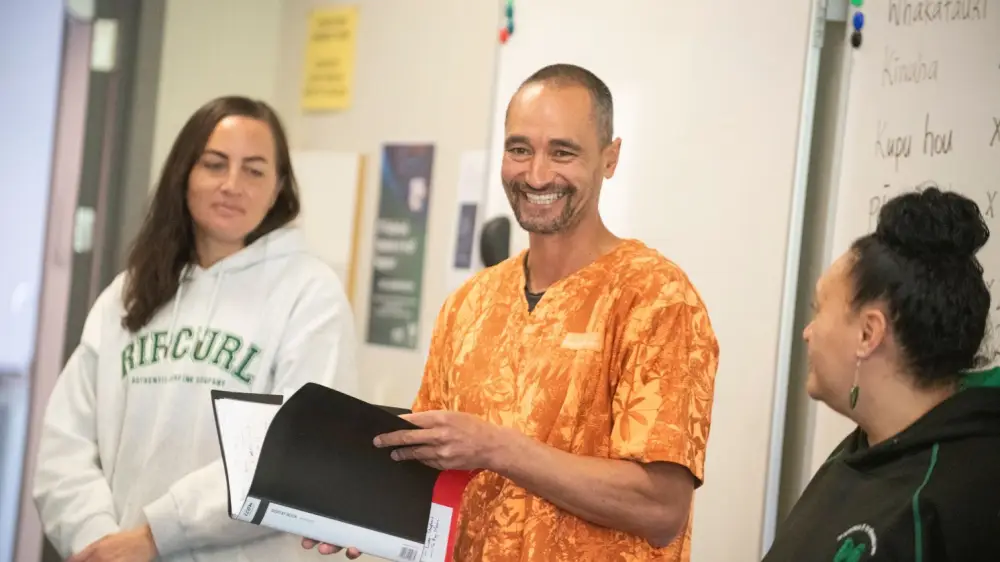
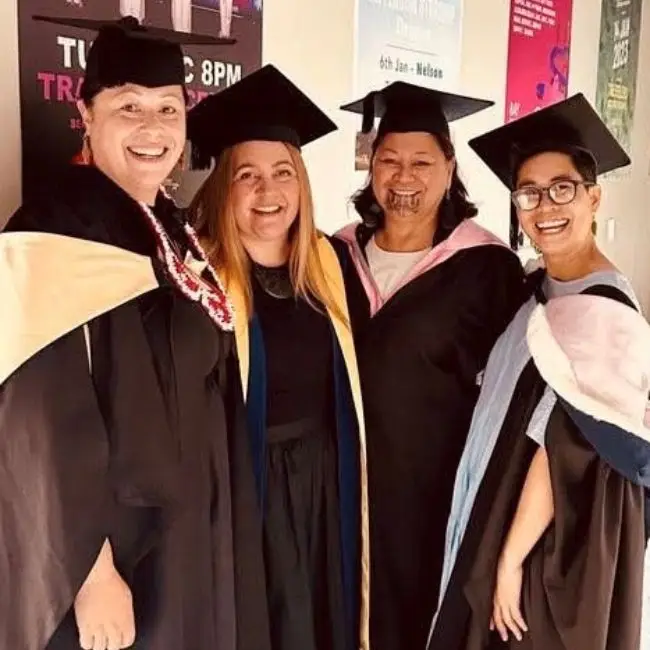
Sue has worked on the applications and enrolments side of tertiary education for over sixteen years, but it was not until she began with NMIT in 2022 that she worked directly with Māori students in a support role.
“I find it incredibly rewarding,” Sue says. “I’m there at the corner of the stage every graduation, so excited for our learners and their achievements.”
Vitally, she says, Te Puna Manaaki provides not only academic support, including study groups and writing assistance, but also fosters a positive, culturally grounded experience that helps ākonga develop a sense of belonging, which ultimately supports their learning journey.
“It’s not just support around education,” Sue explains. “It’s the care, the manaaki, and the balance between the physical and the spiritual — not only the mind, but the pastoral and cultural. I’ve discovered that cultural connection isn't separate from academic success; it’s fundamental to it. A lot of my work is about helping students connect with their whakapapa.”
Sue uses digital records to help students trace relatives, register with their iwi, locate their marae, and reconnect with whānau.
“Once they’ve connected with their whakapapa, they have a new feeling of belonging. It brings them pride – ‘I know who I am.’ It absolutely shows. It gives them a sense of wholeness."
Te Puna Manaaki also acts as an advocate, connecting learners with other services that support their wellbeing and mental health.
Sue developed her research project after Director Māori & Learner Success, Nicole Akuhata, encouraged her to explore and identify the impact Te Puna Manaaki has on learners.
She first completed a literature review in 2023, examining how Polytechnics across Aotearoa support Māori students. However, a lack of available data led her to narrow her focus specifically to NMIT.
To conduct the research, Sue used the Māori ethical framework Te Ara Tika, grounded in tikanga principles, to guide interviews and surveys. She then analysed the data using conductive methods to identify themes and patterns, drawing conclusions through the wellbeing model Te Whare Tapa Whā.
“Nearly one hundred percent of participants found the services helpful,” Sue says. “The majority rated them as extremely or very helpful, and some described them as ‘a lifesaver.’”
In terms of academic performance, students reported tangible improvements in their work.
“Some became A to A+ students while others said the support restored their confidence in their academic ability and motivated them to keep going,” Sue says.
“I concluded that the combination of practical guidance and skill development Te Puna Manaaki focuses on creates lasting benefits for learners throughout their academic journey.”
“The success lies in integrating academic assistance with culturally responsive support,” she added. “When Māori students receive support that honours their cultural identity while addressing their academic needs, the outcomes are significantly positive and measurable.”
Looking ahead, Sue hopes Te Puna Manaaki will reach even more Māori learners at NMIT, and that her research will inspire other ITPs to adopt similar whole-person approaches.
“Te Puna Manaaki offers a valuable insight that could shape the development of best practices throughout New Zealand’s tertiary education sector, particularly in supporting and retaining Māori students.” she says.
In 2024 Māori learners at NMIT achieved a 65% qualification completion rate, nearly 50% higher than the national ITP average and first in the country out of 16 ITPs. NMIT also achieved exceptional course completions rates of 83% for Maori students compared to the sector average of 75% - ranking second in the country out of 16 Institutes of Technology and Polytechnics.
Find out more about Te Puna Manaaki(external link) and how it can help ākonga thrive and feel at home on campus.