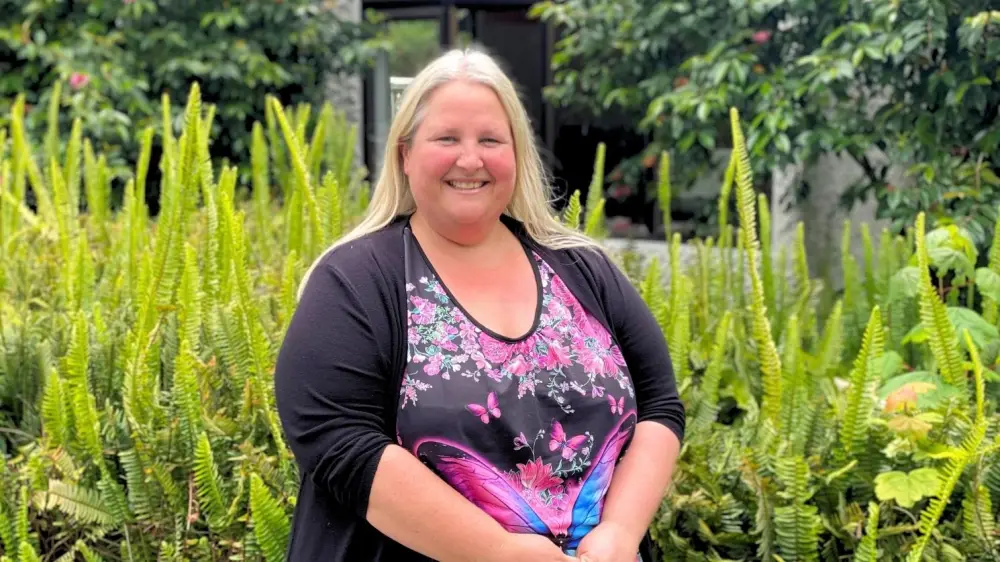
Rachel Summers is looking forward to celebrating the culmination of four years of hard work at graduation, where she will also deliver a speech.
She says the speech is a chance to congratulate her fellow graduates and express her appreciation for those who supported her on her journey toward a Bachelor of Social . While studying for a degree is hard work for all students, Rachel also needed to navigate her learning as a Deaf student which required getting accessibility support.
“NMIT was able to provide funding for New Zealand Sign Language [NZSL] interpreter access and note-taker access. Not many tertiary education providers offer this level of support, and it’s been vital to my studies. Cathy, Paul, and Emily who interpreted for me in class and on my social work placement, and I could not have accomplished this without the support of my tutors and the Learning Support Team.”
While onsite interpretation was key to Rachel’s learning, the reading and writing outside of the classroom presented a challenge.
“I was born Deaf so English isn’t my first language and that made academic language and referencing unfamiliar. I learned what’s called Signed English until I was about fifteen.”
Signed English, or Signed Exact English, is a direct translation of English into manual sign, whereas NZSL is a language in its own right with a different grammar structure than English. NZSL also incorporates facial expressions, expressiveness, and Māori concepts developed by tangata turi [Māori deaf community] to communicate.
“When I was fifteen, I attended a deaf school, so from that time on I learned NZSL, but initially I was signing with English structure. Knowing that structure was quite helpful for my reading and writing, but I had to recall those skills when it came to academic language. That's why I’m so grateful for the Learning Support Team-- a big shout out to Heather.”
To prospective students with accessibility needs, Rachel offers this advice: “Don’t give up. Be determined and know there’s a lot of support out there for you, including from tutors. They all want to see you succeed.”
Alongside her studies, Rachel teaches NZSL at Waimea College in their adult education programme and at Nayland College for Year 9 and 10 students. She is also the Secretary for the Nelson Deaf Community, organising fundraising events, café meet-ups, and fun activities like bingo or dessert nights for Deaf and hearing people to mix and connect.
Working closely with the local Deaf community is what initially empowered Rachel to pursue social work.
“I've advocated for my Deaf community for many years,” Rachel says. “ I have advocated for awareness in the Emergency Department to ensure interpreters are needed promptly when a Deaf person presents at triage. Supporting people helped me develop the advocacy skills I’m using today.”
Her skills have already landed her a role in the social work field: Rachel will be a Youth Mentor Co-ordinator Blenheim at Presbyterian Support in Blenheim, where she also did her final year placement. Rachel says she is excited to work with young people and contribute to the organisation’s mission.
After graduation, Rachel is eager to relax, spend time with her whānau, and settle into her new role.